BRAUNi

Three days, a lecture hall full of teams and one question from B. Braun: how do surgeons get their time back after an operation? Our answer was BRAUNi. And it earned us 3rd place.
-
01 Friday, Nov 28 · 15:00
Lecture hall, agenda, challenges
The hackathon starts where medical students usually sit: in a lecture hall at the University Medical Center Freiburg, hosted by Black Forest Innovation, the medical center and BadenCampus. After registration and the welcome, partners from hospitals, medtech and startups present their challenges, from neurofeedback to surgical documentation.
One challenge has our full attention. B. Braun asks how the documentation around an operation can be made simpler. Every surgeon knows the topic, and nobody enjoys it.
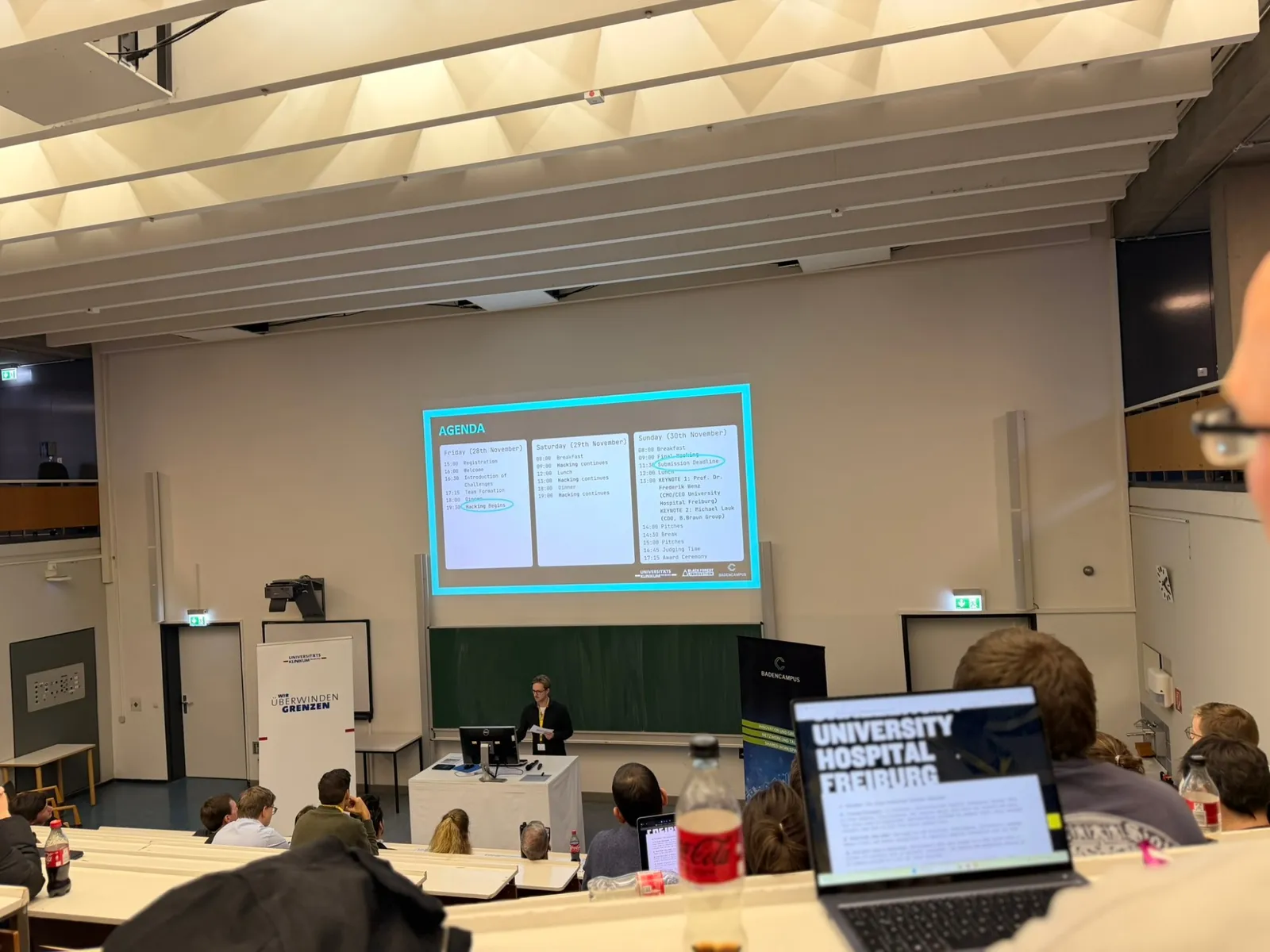
The agenda: hacking starts Friday at 19:30, submission is Sunday at 11:30. 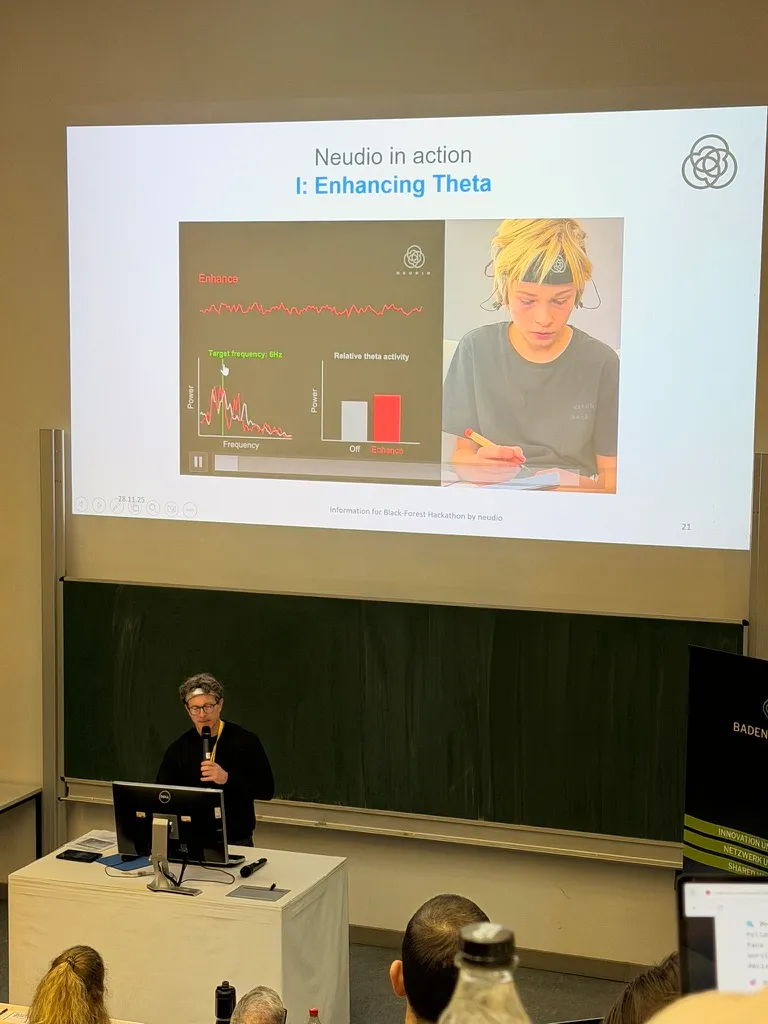
Challenge presentations in the lecture hall, here neudio on neurofeedback. -
02 Friday · 17:15
Listen first, then build
Team formation is at 17:15. Michael Zoidl, Jonathan Häberle and Christoph Saile from alm team up with other participants, including UX/UI design from B. Braun. Before writing a single line of code, we want to understand what the hours after an operation actually look like.
So we talk to the people who live them: physicians on site. The picture is clear. After every operation, surgeons sit in front of five separate systems, gather times, vital signs and findings, write the surgical report, look up OPS codes for billing and fill in the pathology request and post-operative instructions. Roughly an hour that is missing at the bedside.
The surgical report: today and with BRAUNi
Today- Operation ends
- Open five systems
- Gather the data
- Type the report
- Look up OPS codes
about 1 hour per operation
With BRAUNi- Operation ends
- Draft is ready
- Correct by voice
- Sign off
about 2 minutes of review
-
03 Saturday, Nov 29 · 09:00
What can LLMs really do here?
Saturday starts with breakfast and a sober question: where does a language model help, and where must it stay out? Using demo data from a laparoscopic cholecystectomy, the removal of the gallbladder, we test what current LLMs make of timestamps, vital sign curves, anesthesia records and dictation.
The result shapes the entire architecture. Structuring text, writing a report in clinical language, suggesting matching OPS codes: the models do that well. Filling in missing measurements with plausible values: that must never happen in a surgical report. So in BRAUNi, facts always come straight from the source systems. The model writes, every section stays linked to its surgical step, the video and the vital signs, and the surgeon has the final word.
Who provides what in the surgical report
Surgical data DICOM, video, vitals, anesthesia, patient record-
Straight from the source
-
Times and surgical steps
-
Vital signs
-
Video segments
-
-
Written by the LLM
-
Report draft
-
OPS suggestion
-
Pathology and instructions
-
Sign-off by the surgeonThe model writes, the sources prove it, the human decides.
-
Straight from the source
-
04 Saturday · 13:00
Design and prototype
Meanwhile the interface takes shape in Figma. Clear areas instead of five windows: SmartProtokoll for the surgical steps, billing with AI-identified OPS codes, and a timeline that syncs the surgical and anesthesia views. Built for the tablet, because surgeons rarely sit at a desk after an operation. The name comes almost in passing: BRAUNi, with a bitten cookie as its logo.
Into the evening we build, throw away and build again. In between we collect feedback: can you read the report at a glance? Is the right video segment where you need it?
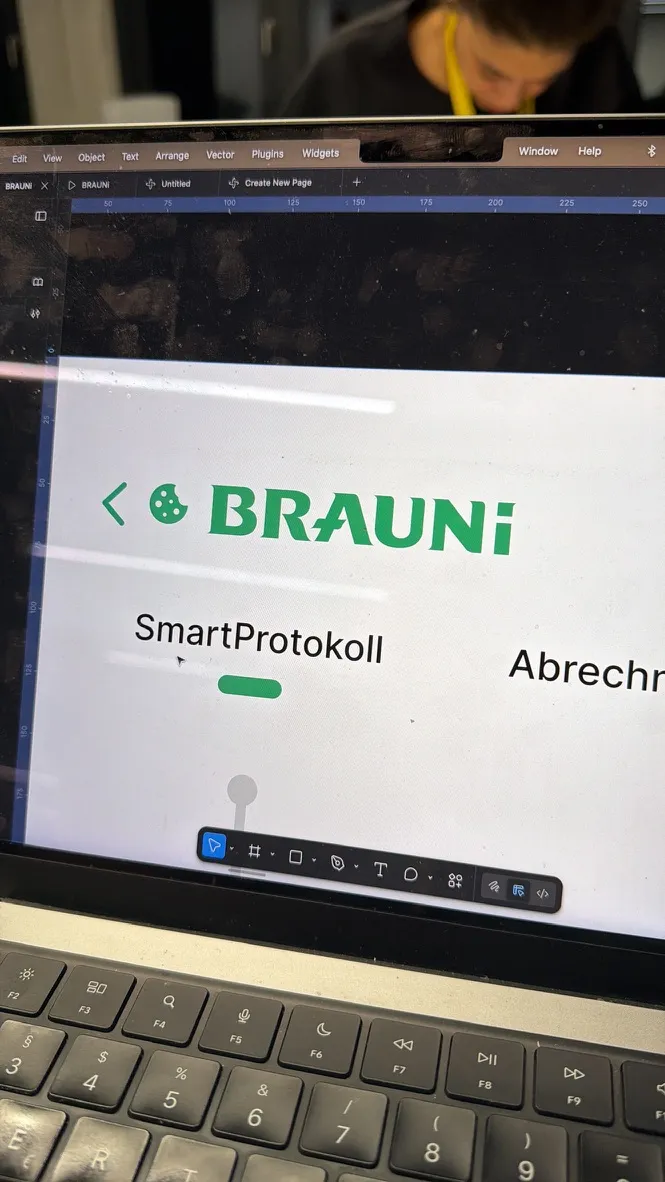
In Figma: SmartProtokoll and billing as separate areas. 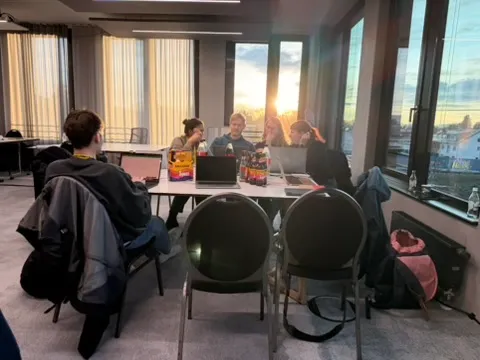
Saturday evening: building until the sun goes down. How BRAUNi is built
-
Sources
- DICOM
- Endoscopy video
- Vital signs monitor
- Anesthesia system
- Patient record
-
BRAUNi
- Synced timeline
- Step-linked data
- AI report draft
- OPS detection
-
Review
- Tablet interface
- Voice control
- Sign-off
-
Outputs
- Surgical report
- Pathology request
- Sync to the HIS
- PDF export
-
Sources
-
05 Sunday, Nov 30 · 09:00
Final hacking and submission
Sunday morning, last round. The demo has to run end to end, from raw data to PDF. Submission deadline is 11:30. What was ready by then:
The demo: one cholecystectomy, end to end
OR systemsBRAUNiSurgeonHIS1 DICOM, video, vitals and anesthesia data2 Sync the timeline, detect steps3 Report draft with OPS 5-511.114 Corrections by voice, sign-off5 Report, codes and requests back to the HIS- OR systems BRAUNi DICOM, video, vitals and anesthesia data
- BRAUNi Sync the timeline, detect steps
- BRAUNi Surgeon Report draft with OPS 5-511.11
- Surgeon BRAUNi Corrections by voice, sign-off
- BRAUNi HIS Report, codes and requests back to the HIS
An hour of documentation becomes a two-minute review.
AI surgical report
The report is generated from all surgical data, in clinical language.
Multidimensional timeline
Surgical and anesthesia views in sync on one time axis.
Step-linked recordings
Every surgical step jumps straight to the matching video segment.
Vitals at each step
Heart rate and SpO₂ exactly where they matter in the report.
Voice-enabled editing
Dictation and corrections by voice, right on the tablet.
AI OPS codes
Matching billing codes, as a suggestion to review.
-
06 Sunday · 14:00
Five-minute pitch, 3rd place
After keynotes by Prof. Dr. Frederik Wenz, CEO of the University Medical Center Freiburg, and Michael Lauk, CDO of the B. Braun Group, the pitches begin. Five minutes per team, with the countdown in plain view next to the stage. We open with the number that matters: 29,000 operations a year at the University Medical Center Freiburg alone, 16.5 million across Germany. Then the demo.
At the award ceremony at 17:15 it is official: 3rd place for BRAUNi, with €1,000 in prize money sponsored by FWTM Freiburg. Plus a golden astronaut.
For us it is more than a prize. In 40 hours, a question, conversations with physicians and a lot of testing turned into a prototype that shows how it can be done. It is how we work with our clients too: understand first, then build, and use AI where it actually holds up.
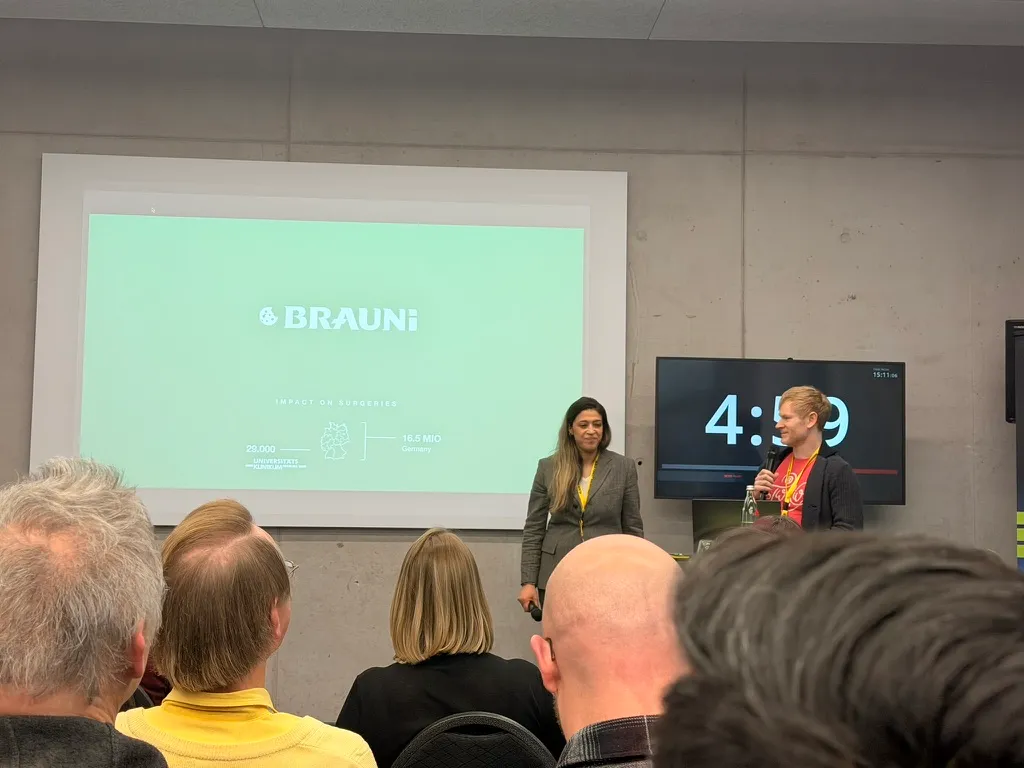
Five minutes for three days of work. The countdown is running. 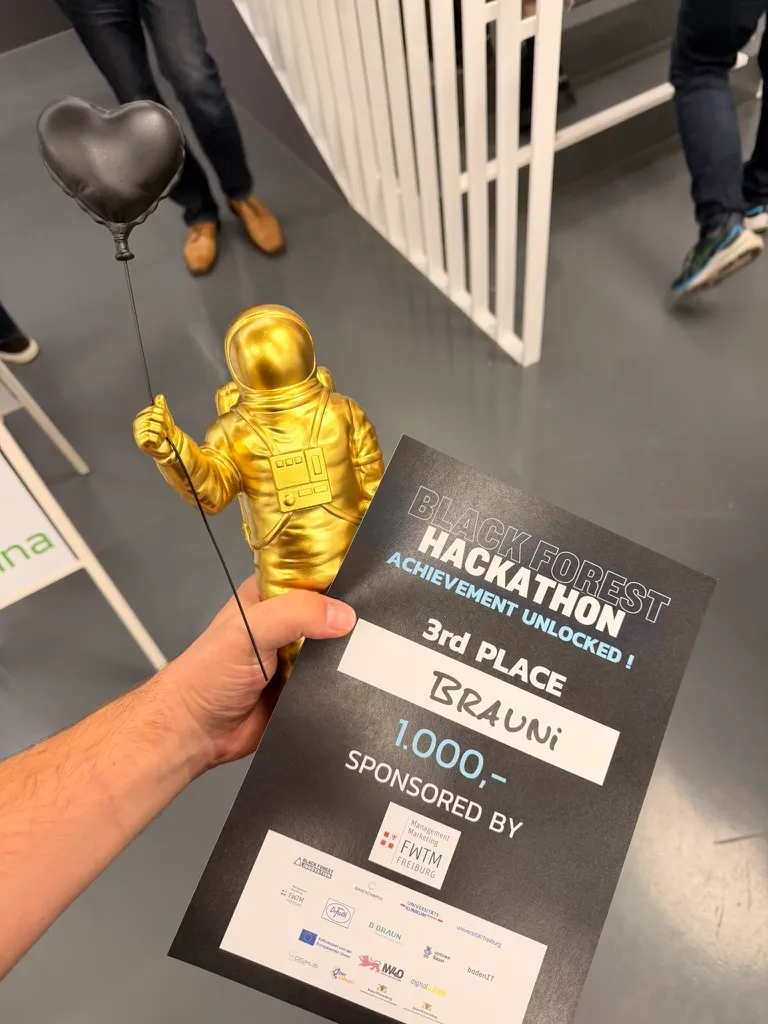
3rd place, €1,000 and a golden astronaut.
Project facts
- Michael Zoidl
- Jonathan Häberle
- Christoph Saile
- Niklas
- Susann
- Choupette
- Philipp Simon (B. Braun · UX/UI)